
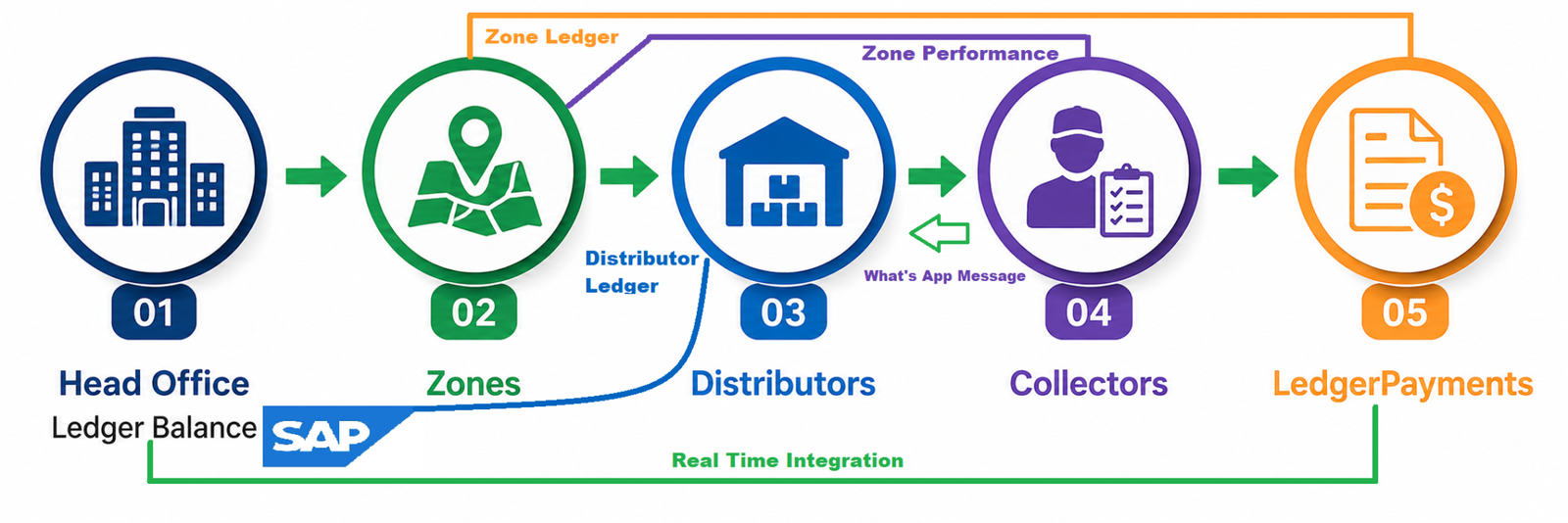
A Unified Collection Hierarchy
The platform is designed around the organizational structure through which collection is actually managed: Head Office Ledger Balance → Zones → Distributors → Collectors → Ledger Payments. This hierarchy allows management to move from enterprise-level performance into increasingly specific operational contexts.
The Transformation: From Manual Reporting to an Always-Available Operating Picture
The GP Collection System was developed as an enterprise recovery and collection platform integrated with SAP. The repository shows dedicated work around SAP API integration, synchronization, SAP logging, role management and operational controls. Collection activity became part of a centralized digital operating model instead of depending solely on periodic manual reporting.
From Manual Collection to Real-Time Recovery Intelligence
The GP Collection System was not built simply to replace paper, spreadsheets, or manual reporting with another software application. It was designed to change the entire recovery management process — from delayed information and reactive decisions to a connected, real-time intelligence platform.
- 01 — Capture: Digitize collection activity at the source. Collection transactions, payments, approvals, ledger information and operational activity are brought into a centralized digital environment, connected with the wider enterprise ecosystem.
- 02 — Connect: Create one connected view across the organization. Head Office, zones, distributors and collectors operate within the same organizational hierarchy and business framework.
- 03 — Understand: Turn operational data into business intelligence. The BI Center transforms collection data into KPIs, trends, performance rankings, recovery intelligence, approval insights, outstanding analysis and interactive drill-downs.
- 04 — Predict: Move from reporting to identifying. ML.NET predictive intelligence analyzes operational patterns to identify risks, opportunities and performance signals.
Real-Time Collection Visibility
One of the most important changes was moving from delayed reporting toward operational visibility. The dashboard and BI architecture supports current performance views alongside defined analytical periods such as MTD, YTD, custom periods, workflow-current state and ledger snapshots.
The implementation contains explicit handling for different time scopes rather than treating every KPI as a simple date-filtered total. A pending approval queue is not simply a historical sum. Outstanding exposure is not necessarily a monthly transaction flow. A current operational queue should not be interpreted as YTD performance. The platform therefore embeds business meaning into the reporting architecture.
Enterprise Business Intelligence Center
Instead of placing multiple disconnected charts around the application, the platform created specialized intelligence modules for different dimensions of collection management:
- Collection Intelligence: Collection performance, trends, dimensions and transactional activity.
- Financial Intelligence: Financial KPIs, collection, outstanding balances, vendor payments, recovery and forecast-related metrics.
- Collector Intelligence: Collector-level performance, approvals, pending activity, rejected activity and performance comparisons.
- Distributor Intelligence: Distributor-level collection, outstanding exposure, performance and risk.
- Geographic Intelligence: Zone-level collection, recovery, approval and efficiency analysis.
- Range Intelligence: Performance and recovery analysis across business ranges.
One Definition of the Truth
A major engineering challenge in enterprise BI is not producing charts — it is ensuring that the same metric means the same thing everywhere. The GP Collection System introduced a canonical calculation layer (BiCanonicalCalculationService) as the authoritative calculation source for metrics including: Total Collection, Net Collection, Pending Collection, Rejected Collection, Approval Rate, Rejection Rate, and Amount Approval Rate.
The repository also contains regression tests specifically validating consistency between executive KPIs, drill-down calculations and report outputs. This changed BI from “different screens calculating similar numbers” to “multiple experiences consuming the same business definition” — a significant enterprise architecture improvement.
ML.NET Predictive Intelligence
ML.NET allows predictive intelligence to operate inside the .NET application environment and reduces dependence on external prediction services for the local ML layer. The platform includes recurring learning workflows, prediction refresh, feedback, auditing and model governance mechanisms designed to support continuous learning.
Authoritative financial and business KPIs remain governed by the business calculation layer. ML is used for pattern discovery, prediction and recommendations — identifying risks, forecasting collection and recovery signals, and surfacing potential opportunities.
Paksa IT Solutions’ Role
Paksa IT Solutions designed and developed the platform as an end-to-end transformation rather than treating collection, reporting, BI and ML as isolated components. The implementation combined:
- Enterprise application engineering
- SAP integration
- Business intelligence architecture
- Canonical KPI design
- Advanced drill-down analytics
- Performance and risk modeling
- ML.NET predictive intelligence
- ML operationalization
- Governance and auditing
Frequently Asked Questions
What is the Paksa Collection System?
The Paksa Collection System is an enterprise collection and recovery management platform designed to centralize collection operations, provide real-time business visibility, support SAP integration, and deliver BI and ML-driven intelligence.
How does the system provide real-time collection visibility?
The system centralizes collection and workflow information and exposes it through executive dashboards, operational views and BI modules with defined business and time scopes.
Does the Paksa Collection System integrate with SAP?
Yes. The implementation includes SAP API integration, synchronization handling, SAP logging and related operational controls.
How is performance measured?
Performance uses an authoritative composite PerformanceScore rather than relying only on total collection. The current ledger-first framework incorporates ledger coverage, approval rate, collection efficiency, pending ratio and rejection rate.
Why use ML.NET?
ML.NET allows predictive intelligence to operate inside the .NET application environment and reduces dependence on external prediction services for the local ML layer.
Does the machine-learning system continuously learn?
The platform includes recurring learning workflows, prediction refresh, feedback, auditing and model governance mechanisms designed to support continuous learning.
